
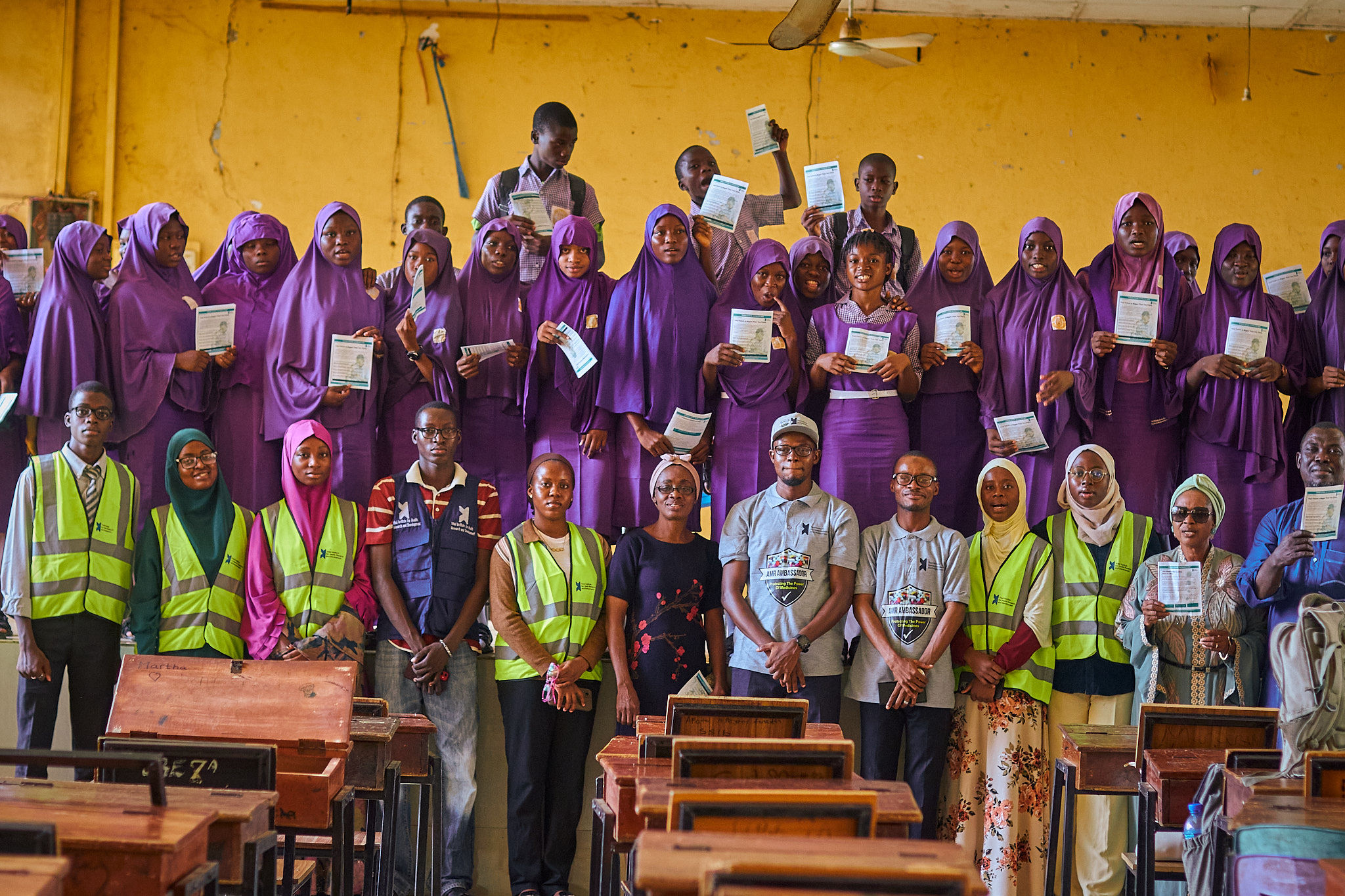

On July 16, 2026, the Triad Institute for Health Research and Development (TIHRAD) carried its science education and public health advocacy mission into the classroom, conducting a half-day outreach programme at Unilorin Secondary School, University of Ilorin Mini Campus, Adewole, Ilorin. The programme brought together approximately 100 SS2 students for a morning of conversations designed to challenge assumptions about science careers and equip young people with knowledge they can take back to their communities.
The outreach was built around two complementary goals. The first was to open students to the breadth of career pathways available within the microbial sciences and related fields, disciplines that remain underexplored among secondary school students at precisely the moment when career decisions begin to take shape. The second was to educate students on the threat of antimicrobial resistance and inspire them to become advocates for responsible antibiotic use within their homes, schools, and communities. Together, these goals reflected TIHRAD’s commitment to the belief that science education and public health awareness are most powerful when they reach people early.
The programme commenced with a brief introduction of TIHRAD to the students, establishing who the organisation is, what it does, and the purpose of the day’s conversations. The team was received warmly by the school administration, building on earlier correspondence TIHRAD had maintained with the school’s Head of Department of Sciences.
The first session was an antimicrobial resistance awareness talk delivered by Director of Research, Innovation, and Public Health Programs, Yusuf Amuda Tajudeen. Rather than opening with a clinical definition, the session began with a story drawn from everyday Nigerian life, a community member who buys antibiotics without a prescription, stops treatment early upon feeling better, and later finds the drug has stopped working. Students were invited to reason through what had gone wrong before the explanation followed.
Director Tajudeen spoke earnestly throughout, using stories and illustrations grounded in the students’ own context. He covered what AMR is and how it develops, the everyday behaviours that accelerate it, what the consequences mean for individuals and communities, and what students can do about it. Students followed attentively, demonstrating clear engagement as the session progressed. The talk closed with the AMR Ambassador Challenge, encouraging each student to carry what they had learned to at least three people in their community before the week ended. AMR awareness flyers were distributed to support this.
Following the AMR session, Director of Research, Policy Development and Strategy, Habeebullah Oladipo led an interactive question-and-answer segment to assess student comprehension. Students responded enthusiastically, with a strong number answering questions correctly and demonstrating genuine understanding of the concepts covered. Gifts had been brought for the occasion, and the energy in the room was high as students competed to respond.
The second session turned to career awareness in the microbial sciences, delivered by Director Habeebullah Oladipo. The session opened with a disarming question to the audience and quickly moved to the work of expanding the students’ picture of what a science career can look like. Director Habeeb introduced students to a range of disciplines and roles they may never have encountered, from Epidemiology and Biotechnology to Bioinformatics, Genomics, and Public Health, framing each not by its title but by the problem it exists to solve. He drew on his own experience studying Microbiology and subsequently Pharmacy, using his path to illustrate that science disciplines often dismissed as narrow or limiting are in fact rich with opportunity. He challenged directly the myths students commonly hear about these fields, offering real examples in their place. He also stressed the importance of intentionality in one’s education and encouraged students to begin building their future now, through free online learning resources, science clubs, webinars, and LinkedIn, making the point that a student in Ilorin with a phone and curiosity is already equipped to begin preparing for global opportunities. Students were asked questions throughout the session to keep engagement active.
The third session featured a pre-recorded video from Director of Research, Strategic Planning and Scientific Advancement, Iyiola Olatunji Oladunjoye, currently pursuing his PhD at Oxford University on an Erasmus Mundus scholarship, tracing his journey from a Nigerian secondary school to one of the world’s leading research universities through the study of Microbiology. The MC opened a short discussion with students on questions they would want to ask Dr. Iyiola, keeping the spirit of the segment alive.
Towards the close of the programme, refreshments were shared with students as a gesture of appreciation for their time and participation. Data collection for TIHRAD’s ongoing research into the impact of school-based AMR awareness interventions was completed by volunteers on ground during this period, using a digital assessment administered via Google Form. The team also presented refreshments to the school’s teachers in gratitude for the institution’s hospitality and cooperation. A group photograph was taken before the team packed down and departed.
Directors Habeebullah Oladipo and Yusuf Tajudeen took a moment at the close of the day to speak to the volunteers, offering encouragement and recognition for their contributions to the programme.
The outreach was made possible by a committed team that included Programme Manager Rashidat Yusuf, MC & AV Coordinator Abdulrahman Mohammed, Sarat Jimoh who managed videography, and volunteers Taiye Apata, Zainab Maruf, Khadijat Aleshinloye, Ikram Ahmad, and Faruq.
TIHRAD is proud of what the team delivered on July 16 and remains committed to expanding this model of community-facing science education and public health engagement across Kwara State and beyond. The data gathered through the outreach’s assessment component will contribute to the growing body of evidence on AMR awareness in Nigerian secondary schools, supporting TIHRAD’s advocacy for the integration of health literacy into formal education. The organisation looks forward to building on the relationships established with Unilorin Secondary School and to future outreach engagements that continue to carry this work forward.
Leave a Reply