
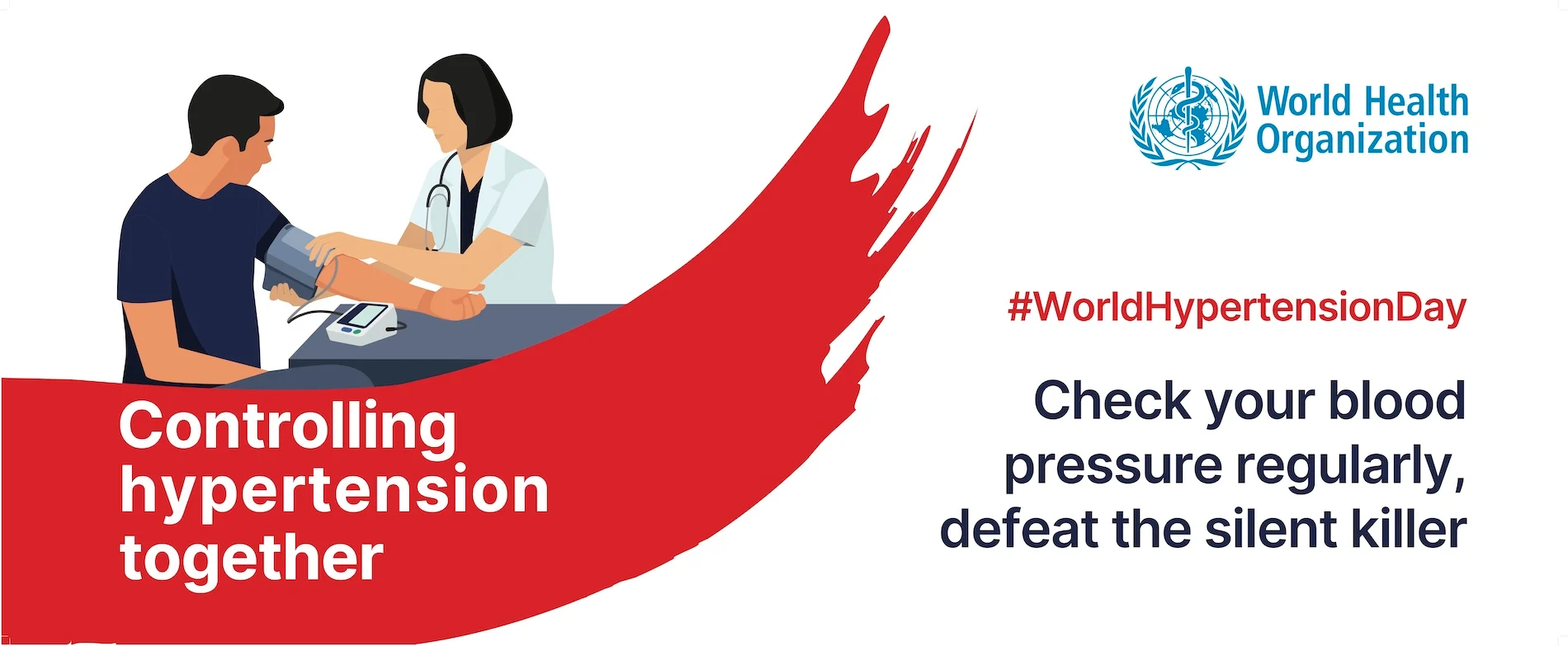

On World Hypertension Day 2026, TIHRAD explores why controlling the world’s leading cardiovascular risk factor demands more than individual effort, and what collective responsibility actually looks like in practice.
At 37, Daisy Mpofu had every reason to believe she was fine. She was the kind of person health campaigns are made to celebrate. She laced up her trainers twice a week and ran through the streets of Watford, two or three miles at a stretch. She was doing exactly what someone who wishes to lead a healthy lifestyle should. She had cut meat from her diet years ago. She watched what she ate. She was not overweight nor sedentary, nor was she stressed beyond the ordinary pressures of teaching primary school children. When colleagues complained of fatigue or headaches, Daisy was rarely among them. She felt well. She looked well. By every signal her body was sending her, everything was fine. As a result, Daisy had not had her blood pressure checked since 2019. The reading then had been normal. She had no reason to think that had changed.
It was a Thursday afternoon when her head-teacher made an announcement to the staff at Stanborough Primary School: a school governor had received some training in blood pressure measurement and would be available to check anyone who wanted one. Daisy almost did not bother. However, something, curiosity, perhaps, or the idle thought that it had been a while, made her roll up her sleeve.
The governor placed the cuff on her arm, pumped it up, and waited. Then she looked at the reading. Then she looked at Daisy. The numbers were 162 over 108.
For context: a healthy blood pressure sits below 140 over 90. Daisy’s reading did not hover just above that line. It was significantly and dangerously elevated. This kind of number, sustained over months or years, thickens artery walls, strains the heart, damages the delicate vessels of the kidneys, and dramatically raises the risk of stroke. She had seen no warning. None of the traditional signs of a high bllod pressure; headaches, dizziness, shortness of breathe, nothing at all, except a number on a screen that was contradictory to whatever she thought she knew about her own health.
Her first instinct, understandably, was disbelief. She had come straight from a classroom full of children. Perhaps the day’s exertion had pushed the reading up. A colleague offered to bring in a home monitor the next day so she could check again at a quieter time. The result was still high. She made an appointment with her GP. Over the following week, she monitored her blood pressure at home, logging reading after reading and every one of them confirmed what the school governor’s cuff had first revealed.
She was prescribed medication. Her pressure came down. Furthermore, in the weeks that followed, as Daisy processed what had happened, she began asking questions of her family that had never been asked before. The answers were sobering: hypertension, it turned out, had been quietly present across generations.
“Had I not had my blood pressure checked then,” she said, “I probably would not have identified the fact I had high blood pressure, as I just assumed it was still fine because it was okay a couple of years ago.”
She paused, then added: “It has also changed my perception that it is something you get when you are old. I am encouraging all my friends to take a test if they have not recently.”
Daisy Mpofu did not defeat hypertension through medical sophistication. She defeated it because a governor took a training course and a colleague happened to own a monitor. Ordinary acts by ordinary people (that were not healthcare workers) created the chain of events that may have saved her life.
The above true life story encapsulates what the 2026 World Hypertension Day theme is really telling: Controlling Hypertension Together: Check Your Blood Pressure Regularly, Defeat the Silent Killer.
Hypertension is the world’s leading modifiable risk factor for cardiovascular disease, stroke, and premature death. It affects an estimated 1.3 billion people globally, and according to the World Health Organisation, fewer than half of those living with the condition are even aware of their diagnosis. Of those who know, only about one in five has it under adequate control. These statistics reflect what happens when a condition with no reliable symptoms is left to announce itself through its consequences.
The conventional framing of hypertension in public health communication has long defaulted to the language of individual responsibility: reduce salt intake, increase physical activity, maintain a healthy weight, take prescribed medications, and know your numbers. This advice is clinically sound. But it carries an embedded assumption that the primary barrier to hypertension control is insufficient personal effort, which the evidence does not support. Daisy exercised regularly. She maintained a healthy diet. She was, by any reasonable standard, doing everything right. And she still had a blood pressure reading that put her at serious risk of catastrophic organ damage. The gap between healthy behaviour and dangerous physiology is precisely the gap that individual responsibility alone cannot bridge.
Cardiovascular medicine has long recognised that the social determinants of health, income, education, housing, access to care, food, and environments are among the strongest predictors of hypertension prevalence and control. Communities with limited access to affordable, nutritious food, safe spaces for physical activity, and functioning primary healthcare consistently carry a higher burden of uncontrolled hypertension. In low- and middle-income countries, where that burden is most acute, the structural deficits are most severe.
What collective responsibility looks like in practice depends on which layer of the collective we are examining.
At the community level, it looks like what happened at Stanborough Primary School: an employer creating a health moment that the formal healthcare system had not. Communities that normalise routine blood pressure checks change the environment in which hypertension operates. Faith institutions, workplaces, schools, and traditional leaders carry a kind of proximity and trust that no health ministry can replicate. When these institutions make space for preventive health action, they reach people who would never have walked into a clinic on their own initiative.
At the health system level, collective responsibility means designing care that moves toward people rather than expecting people to navigate their way toward care. Task-shifting blood pressure measurement to trained volunteers and community health workers has demonstrably expanded detection in settings where health worker shortages make facility-based models insufficient.
At the policy level, genuine collective responsibility means confronting the upstream determinants that health ministries alone cannot address. Hypertension rates are shaped by what food regulators permit in the sodium content of processed products, by whether urban environments are designed to support or discourage physical activity, by whether essential antihypertensive medicines are included in national formularies and kept consistently in stock at the primary care level. These are decisions made by planners, trade negotiators, finance ministers, and agricultural policymakers. An advocacy agenda for hypertension that does not engage this terrain is treating symptoms while leaving causes untouched.
Daisy’s story also dismantles one of the most persistent and dangerous myths surrounding hypertension: that it is a disease of older age or of visible ill-health. She was 37. She was active. She was health-conscious. She had no symptoms. This misperception that youth or fitness confers protection is one of the most consequential barriers to early detection, keeping younger adults from seeking checks and giving the condition uninterrupted years to do its damage. Clinicians frequently encounter patients whose first awareness of hypertension comes only after a hypertensive crisis, a stroke, or findings of end-organ damage on investigations prompted by something else entirely.
The most haunting detail in Daisy’s account is not the reading of162 over 108. It is the years that passed between her last normal check and that Thursday afternoon in Watford. That is the defining character of this condition. It imposes no obvious cost until it is ready to collect everything at once.
Daisy is well now. Her blood pressure is controlled. She monitors it at home and understands, in a way she did not before, what that number means and why it matters. However, her story does not end with her. She is talking to her friends, urging those her age to get checked. Her family has opened a long overdue conversation. A ripple is spreading outward from a single afternoon in a school corridor in Watford. That is what “together” looks like when it is working. Not merely a campaign slogan, but a living, spreading awareness that moves from person to person, from community to system to policy, until the silent killer runs out of places to hide.
At TIHRAD, our work across non-communicable diseases and health systems research is rooted in the conviction that evidence must reach people, not just journals.
References
Herts and West Essex Integrated Care System. (n.d.). Blood pressure patient stories: Daisy Mpofu. NHS. https://www.hertsandwestessex.ics.nhs.uk/your-health-and-care/stay-well/high-blood-pressure/blood-pressure-patient-stories/
World Health Organization. (2023). Hypertension. https://www.who.int/news-room/fact-sheets/detail/hypertension
Mills, K. T., Stefanescu, A., & He, J. (2020). The global epidemiology of hypertension. Nature Reviews Nephrology, 16(4), 223–237. https://doi.org/10.1038/s41581-019-0244-2
Leave a Reply