
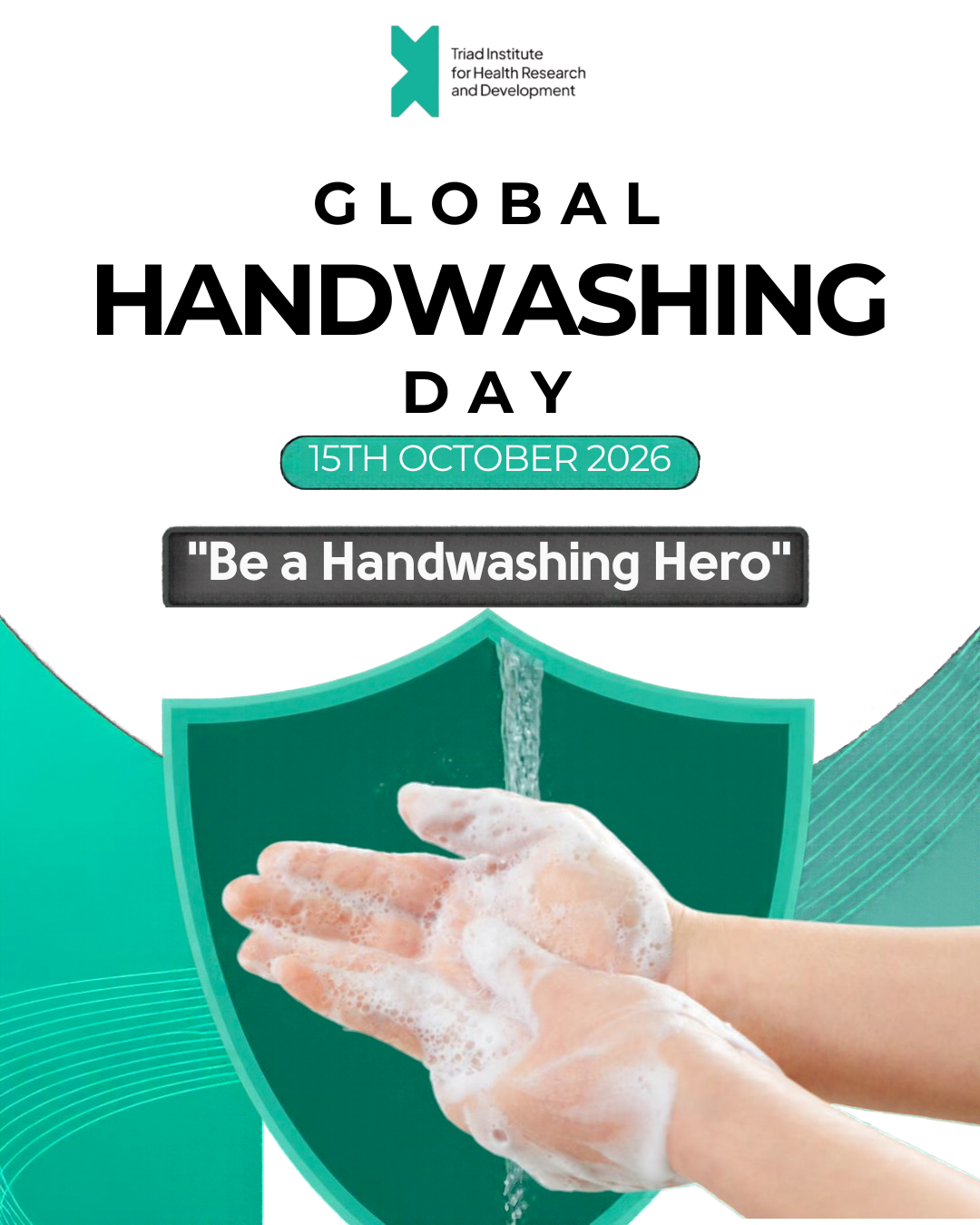

Global Handwashing Day, 15 October 2026
Think about everything your hands touched today. Door handles, phones, money, food, a child’s hand, a handrail. Now think about how often they then went near your face. Most of us do this without noticing, and it is one of the main ways germs find their way into our bodies.
Every year on 15 October, Global Handwashing Day asks us to pause and take this seriously. This year’s theme, “Be a Handwashing Hero,” carries a simple message: anyone, from a young child to a senior official, can lead by washing with soap and encouraging others to do the same (Global Handwashing Partnership, 2025).
How germs travel, and where soap steps in
Germs from faeces, coughs, sneezes and contaminated surfaces land on our hands every day. From there they can get into the body through the eyes, nose and mouth. They can also slip into food and drink while we prepare or eat it, or move onto objects like tabletops, handrails and toys, where the next person picks them up (Centers for Disease Control and Prevention [CDC], 2024).
Soap interrupts this chain. It lifts soil and microbes off the skin so that running water can carry them away, and people tend to scrub more thoroughly when they use soap, which helps even further (CDC, 2024).
What the evidence says
Handwashing has been studied extensively. A Cochrane review, one of the most trusted forms of medical evidence, found that programmes promoting handwashing reduce episodes of diarrhoea by about 30% (Ejemot-Nwadiaro et al., 2021). The CDC (2024) adds that teaching people to wash their hands also lowers colds and similar respiratory illnesses in the general population, and cuts school absence caused by stomach illness.
There is a wider benefit too. Fewer infections mean fewer unnecessary antibiotics, and overuse of antibiotics is a major driver of antibiotic resistance (CDC, 2024). A bar of soap is, in that sense, quietly protecting some of our most important medicines.
The gap that remains
Knowing what to do is only half the story. In 2024, an estimated 1.7 billion people still lacked basic hygiene services at home, including 611 million with no handwashing facility at all (World Health Organization [WHO] & United Nations Children’s Fund [UNICEF], 2025). Habit is a challenge as well. Global estimates suggest that only about 19% of people wash their hands after using the toilet (CDC, 2024). Closing both gaps, through access to water and soap and through everyday habit, is what the day is really about.
How to wash your hands properly
You do not need special equipment, only a few extra seconds of care. The CDC (2024) recommends five steps:
- Wet your hands with clean, running water and apply soap.
- Lather well, including the backs of your hands, between your fingers and under your nails.
- Scrub for at least 20 seconds.
- Rinse thoroughly under clean, running water.
- Dry with a clean towel, or let your hands air dry.
Dry hands matter more than they seem, because germs transfer more easily to and from wet hands (CDC, 2024).
When to wash
Before preparing or eating food, after using the toilet or changing a baby’s nappy, after coughing, sneezing or blowing your nose, and before and after caring for someone who is sick are the key moments. If you build the habit around these, you cover most of the risk.
Four myths worth retiring
“Hot water kills germs, so hotter is better.” It does not. The temperature of the water does not appear to affect how well germs are removed, and hot water can irritate your skin and costs more energy (CDC, 2024). Use whatever is comfortable.
“Antibacterial soap works better.” For everyday use at home, it does not. The U.S. Food and Drug Administration (FDA, 2016) stopped companies from marketing consumer washes with 19 antibacterial ingredients, including triclosan, because they were not shown to be safe for long-term daily use or any more effective than plain soap and water. Plain soap is enough.
“Hand sanitizer is just as good.” Sanitizer is a useful backup, not a replacement. The CDC (2024) advises using one with at least 60% alcohol when soap and water are not available, but notes that soap and water remove more kinds of germs, including norovirus, and also remove chemicals. Sanitizer works poorly on hands that are visibly dirty or greasy.
“A quick rinse is enough.” Scrubbing creates the friction that helps lift germs off the skin. Research suggests that washing for about 15 to 30 seconds removes more germs than shorter washes, which is why about 20 seconds is the widely recommended standard (CDC, 2024).
Be a handwashing hero this year
Heroism here is small and practical. It looks like washing before you cook, showing a child how to scrub between their fingers, making sure the sink at school or work has soap, or gently reminding a family member before dinner. Habits spread through example, and every person who washes properly makes the people around them a little safer.
This Global Handwashing Day, try this: wash your hands properly at the next key moment, and show one other person how. It takes about 20 seconds, and it is one of the best things you can do for your health and for the people you love.
References
benjohnson. (2025, August 25). JMP – Progress on household drinking water, sanitation and hygiene 2000-2024 – UNICEF DATA. Unicef DATA. https://data.unicef.org/resources/jmp-report-2025/
CDC. (2024, June 13). Handwashing facts. Clean Hands. https://www.cdc.gov/clean-hands/data-research/facts-stats
Centers for Disease Control and Prevention. (2024, April 30). Hand Sanitizer Guidelines and Recommendations. Clean Hands. https://www.cdc.gov/clean-hands/about/hand-sanitizer.html
Ejemot-Nwadiaro, R. I., Ehiri, J. E., Arikpo, D., Meremikwu, M. M., & Critchley, J. A. (2021). Hand-washing promotion for preventing diarrhoea. Cochrane Database of Systematic Reviews, 12(1). https://doi.org/10.1002/14651858.cd004265.pub4
FDA. (2019, May 16). Antibacterial soap? You can skip it, use plain soap and water. U.S. Food and Drug Administration. https://www.fda.gov/consumers/consumer-updates/antibacterial-soap-you-can-skip-it-use-plain-soap-and-water
Global Handwashing Partnership. (2025). Global handwashing day. Globalhandwashing.Org. https://globalhandwashing.org/global-handwashing-day/

Leave a Reply