

Imagine a rural clinic in Kenya where a child’s fever spikes, and the lab cannot return a culture result for days. The doctor, armed with an AI-powered decision-support app, instantly receives a personalized antibiogram that indicates the most likely resistant pathogens in the region and suggests a narrow-spectrum regimen.
This is not science fiction, it is the promise of artificial intelligence (AI) reshaping how we fight antimicrobial resistance (AMR) in low- and middle-income countries (LMICs).
Every year AMR claims roughly five million lives, and the heaviest burden fall where over- the-counter antibiotics are handed out like candy. Traditional guidelines update slowly, leaving clinicians to treat with outdated information, but AI can move at the speed of data, which can keep pace with evolving resistance patterns, turning static protocols into living, learning systems.
Three ways AI is already making an impact
1. Early-warning surveillance – Machine-learning models process wastewater reports, hospital admission, and pharmacy data to detect rises in resistant organisms before they become outbreaks. A federated learning platform in Tunisia showed a 30 % faster detection for carbapenem-resistant Enterobacteriaceae, an achievement impossible with manual reporting.
2. Diagnostic support – Deep-learning tools interpret culture plates and rapid antigen tests, then deliver actionable recommendations to the clinician. A pilot in Kenya showed a 22% drop in inappropriate prescriptions while improving patients’ clinical outcomes.
3. Drug Discovery – Generative AI models foresee new antibiotic structures that can be synthesized locally, cutting costs and supply-chain delays. In 2024 a team put together a pipeline that identified a compound capable of dealing with multidrug-resistant Acinetobacter baumannii. Their work suggests a future where low- and middle-income countries can start making their own lifesaving medicines.
Challenges and possible solutions
The biggest challenges right now are the lack of data, unstable digital networks, and the need for solutions that actually fit local settings. Federated learning helps hospitals train models together without exposing private data. Open-source tools keep costs down, and programs like the African AI for Health initiative are training health workers to become co-designers instead of end-users.
AI can be of great assistance in the fight against resistant infections, especially where resources are limited and the AMR burden is heavy. It can give us immediate observation, faster diagnostics, and even help generate new drugs, if we invest in the data, infrastructure, and local knowledge needed to make those tools reliable and sustainable.
To briefly put it, the digital age offers a chance to stop AMR from getting worse if we fight it together. As World Antimicrobial Week 2025 reminds us, “Act now: protect our present, secure our future.” AI can turn that slogan into reality.
References
1. World Health Organization. (2023). Antimicrobial resistance: Fact sheet.
2. Kenya SMS antibiotic stewardship study. (2022). Journal of Global Health, 12(4), 456–463. 3. African AI for Health initiative. (2024). Lancet Digital Health, 6(5), e320–e327.
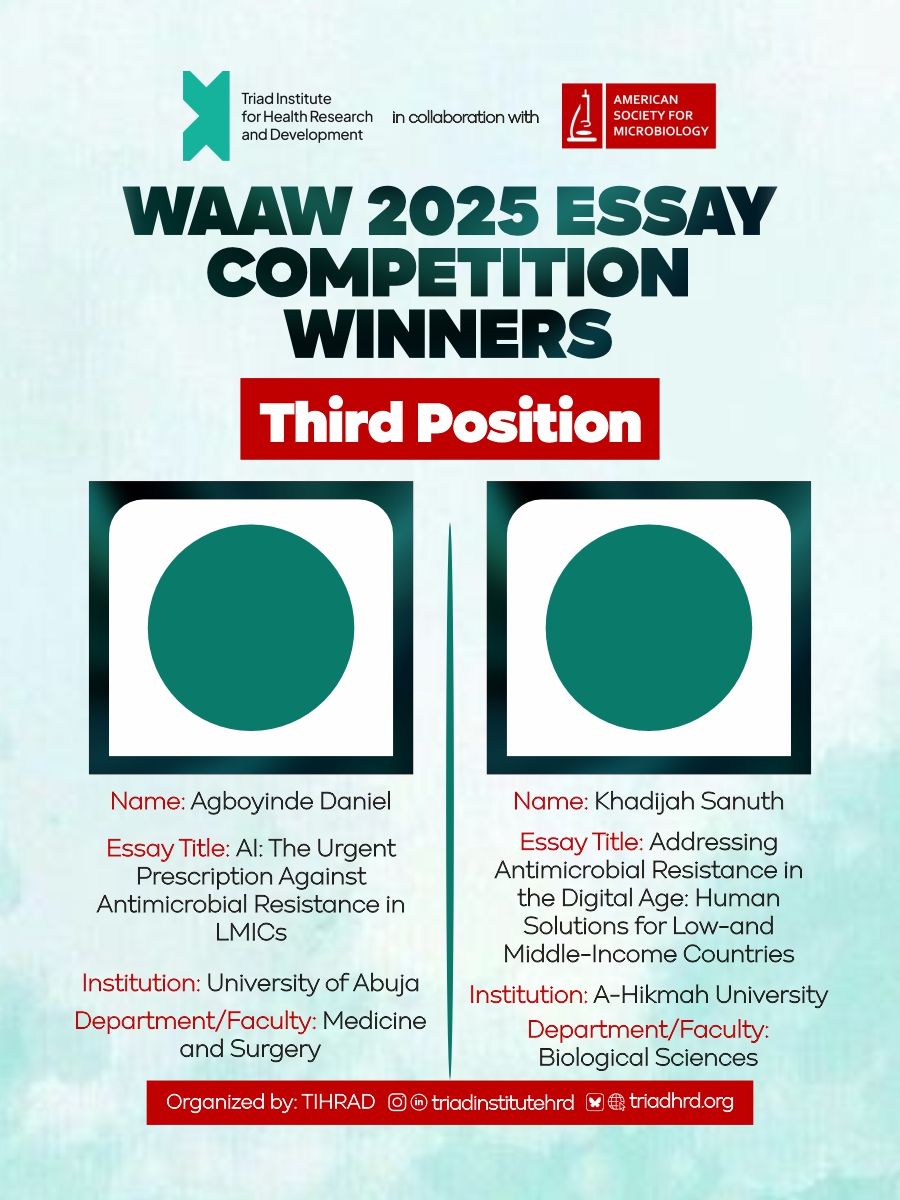
THIRD POSITION: WAAW Essay Competition
Name: Khadijah Sanuth
University: Al-hikmah University
Program: Biological Sciences
Leave a Reply